Quick Answer
AI does not replace the X-ray. It reads the same X-ray more closely, flagging early cavities that are easy for the human eye to miss. In studies, AI has caught roughly twice as many early between-teeth cavities as dentists reviewing the same images. For patients in Beverly, that can mean catching a problem while a small filling will still fix it, rather than waiting until it needs a root canal. Your dentist still makes the final call.
Cavities are sneaky. The early ones rarely hurt and can hide between teeth or in tiny grooves, hard to see even on an X-ray. By the time they are obvious, they are often bigger and costlier to fix.
That is where AI-assisted diagnostics come in. At Smiley Dental Beverly, every patient exam already includes AI-enhanced X-ray analysis, a second set of eyes that helps catch problems earlier. Here is what that technology actually does, what the research shows, and what it means for your tooth cavity treatment.
What Does AI Cavity Detection Actually Do?
The name sounds futuristic, but the idea is simple. AI cavity detection is software trained on enormous numbers of dental X-rays, each labeled by experts to show where cavities are.
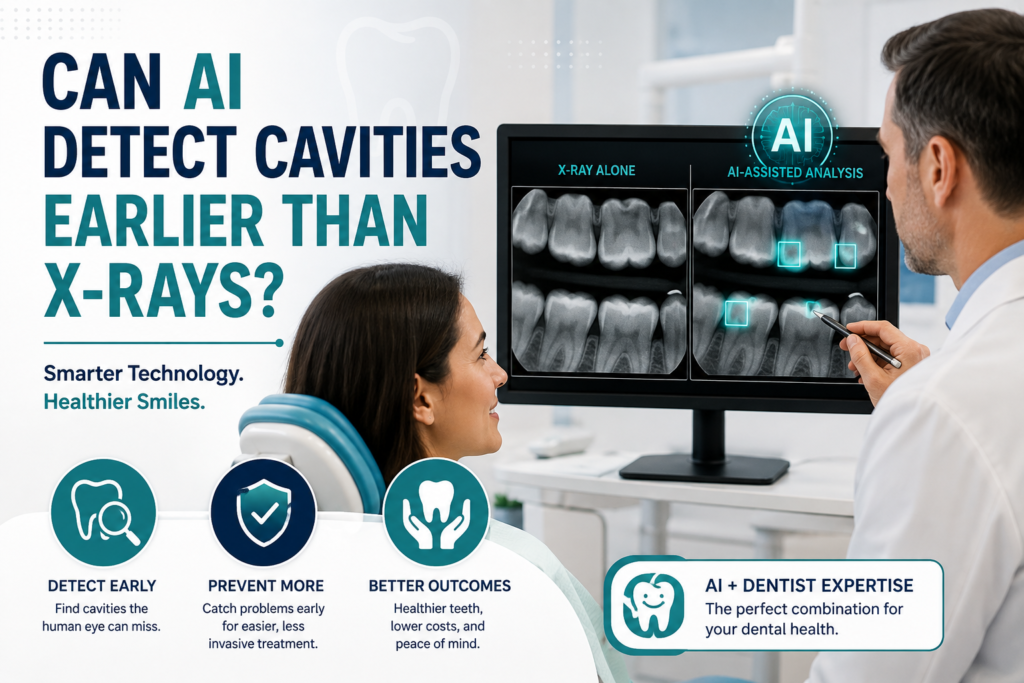
After learning from those examples, the software can scan a new X-ray and highlight areas that look like early decay. It does not take a separate image or add any radiation. It analyzes the same digital X-ray your dentist already takes, then marks spots worth a closer look.
Think of it as spell-check for X-rays. The dentist is still the writer making every decision, but the tool quietly flags things easy to overlook when you review images all day.
Why Catching Cavities Early Matters So Much
A cavity is not a fixed thing. It is decay that keeps spreading until treated, and the further it goes, the more it costs in money, time, and comfort.
Caught early, a small cavity needs only a simple filling. Left to grow, that same spot can reach the nerve and require a root canal and crown, or even an extraction. Early detection is the difference between a quick, affordable visit and a long, expensive one.
Early lesions can also be stopped before they ever need a drill. Fluoride, sealants, and better home care can sometimes halt or reverse decay that is caught at the very beginning, which is a core goal of good preventive dental care.
What the Research Says About AI Accuracy
This is where it helps to look past marketing claims and at real clinical studies. The findings are encouraging, with an important caveat we will get to.
A 2025 umbrella review in the journal PLOS One pooled results from fourteen systematic reviews of AI caries detection. Across the data, AI reached a sensitivity of about 85 percent and a specificity of about 90 percent. In plain terms, sensitivity is how often it correctly catches a real cavity, and specificity is how often it correctly clears a healthy tooth.
Even more striking is a comparison of AI against dentists reading the same bitewing X-rays. In a widely cited study by Cantu and colleagues, AI detected early between-teeth cavities with about 75 percent sensitivity, while the dentists caught only about 36 percent. The AI found roughly twice as many of the early lesions the human eye missed.
That gap matters most for the trickiest cavities: the small, early ones between teeth and in hard-to-read areas. Those are exactly where a second set of eyes pays off.
Traditional X-Ray Reading vs AI-Assisted Reading
Both start with the very same X-ray. The difference is in how it gets reviewed. Here is a side-by-side:
| Factor | X-Ray Alone | X-Ray Plus AI |
|---|---|---|
| What it catches | Visible and moderate decay | Also flags subtle early spots |
| Early between-teeth cavities | Easy to miss | Highlighted for review |
| Speed | Depends on review time | Instant highlighting |
| Consistency | Varies with fatigue | Same standard every time |
| Role of the dentist | Reads and decides | Reviews, confirms, decides |
| Radiation to patient | Standard X-ray dose | No extra radiation |
| Typical added cost | None | Usually none to the patient |
The AI never overrides the dentist. It adds a layer of review, and your dentist confirms every finding before anything is recommended.
How an AI-Assisted Exam Works, Step by Step
If you are curious what actually happens at your visit, here is the process from start to finish:
- You get a normal digital X-ray. Nothing changes here, and there is no extra radiation or added time.
- The software analyzes the image. Within seconds, the AI scans the X-ray and highlights areas that may show early decay.
- Your dentist reviews the highlights. The dentist looks at each flagged spot alongside their own reading of the image.
- Findings are confirmed clinically. The dentist checks the tooth in your mouth to confirm what the images suggest.
- You see it too. The marked images make it easy for the dentist to show you exactly what they see.
- You decide together. With a clear picture, you and your dentist agree on whether to watch, prevent, or treat.
That last point is a quiet benefit. Seeing your own X-ray with the trouble spots marked makes the conversation clearer, so you are never just taking someone’s word for it.
Curious what an AI-assisted exam looks like?
Every exam at Smiley Dental Beverly includes AI-enhanced X-ray analysis. Call 978-288-1000 or request an appointment online to experience it for yourself.
AI Is a Second Set of Eyes, Not a Replacement
This is the part the hype often skips, and it is the most important. AI does not diagnose your cavities. Your dentist does.
The software is good at flagging patterns, but it does not know your history, feel the tooth, or weigh the dozens of judgments a dentist makes. It can also flag something that turns out to be nothing, which is why a trained clinician reviews every result.
Used well, AI makes a good dentist a little sharper, catching the occasional early spot that a long day might otherwise hide. That combination of human judgment and machine consistency is the heart of the AI-powered modern dentistry approach at our Beverly office.
Is AI-Assisted Detection Safe, and Does It Cost More?
On safety, the answer is reassuring. Because the AI reads an X-ray you were already having taken, it adds no extra radiation and no extra scans. It is simply a smarter review of an existing image.
On cost, the AI analysis is typically built into the exam rather than billed separately, so it usually costs the patient nothing extra. The real savings come later, when catching a cavity early means a small filling instead of a root canal.
Why This Matters Even More for Kids
Early detection is valuable at any age, but it is especially useful for children. Young teeth have thinner enamel, so decay can spread quickly, and kids are not always able to say when something feels off. Catching a cavity early in a child’s developing smile protects the adult teeth forming underneath. That is one reason AI-assisted review fits naturally with attentive children’s dentistry.
How to Stop Getting Cavities in the First Place
The best cavity is the one that never forms. Technology helps you catch decay early, but prevention keeps it from starting. Here is how to lower your risk:
- Brush twice a day for two minutes with fluoride toothpaste.
- Floss daily, since that is where between-teeth cavities begin.
- Cut back on sugar and sipping, especially sodas and constant snacking.
- Drink water, which rinses the mouth and, when fluoridated, strengthens enamel.
- Ask about sealants and fluoride, simple protections that are especially good for kids.
- Keep regular checkups, so any early decay is caught while it is small.
One more note: if you notice sensitive teeth or a twinge with hot or cold, mention it at your visit. Sensitivity does not always mean a cavity, but it is worth checking, and it can be an early clue.
Expert Tip
When you are at your exam, ask your dentist to show you the AI-marked X-ray on the screen. Seeing the flagged spots for yourself turns an abstract recommendation into something you can actually understand, and it makes it easier to decide between watching a tiny spot and treating it. A good practice will happily walk you through the images.
AI-Enhanced Care at Smiley Dental Beverly
Our Beverly dental office at 45 Dodge Street builds AI-enhanced X-ray analysis into every patient exam, so early detection is standard, not an upsell. We serve Beverly, Danvers, Salem, Peabody, Wenham, Hamilton, Ipswich, and the wider North Shore.
- AI-enhanced X-ray analysis on every exam, catching problems earlier for more conservative treatment.
- Findings reviewed on screen, so you see what we see and understand your options.
- An experienced team, named among America’s Best Dentists and members of the American Academy of Cosmetic Dentistry.
- A prevention-first mindset, using early detection to keep treatment small and simple.
As a trusted dentist in Massachusetts serving the North Shore since 2013, we pair modern tools with old-fashioned attention. The technology assists, but the care is personal.
Frequently Asked Questions
In a 2025 umbrella review in PLOS One, AI caries detection reached about 85 percent sensitivity and 90 percent specificity across many studies. In one comparison, AI caught roughly twice as many early between-teeth cavities as dentists reading the same X-rays. Accuracy varies by lesion type, and a dentist confirms every finding.
Yes. AI software is trained on huge numbers of labeled X-rays, so it can scan a new image and highlight areas that may show decay. It works on the standard digital X-rays your dentist already takes, adding a layer of review rather than a new scan.
AI is being used to help spot bone loss from gum disease, flag issues on panoramic images, and support treatment planning. Accuracy is strong for well-defined tasks like caries detection, but it varies by application, and results always go through a dentist. It is a support tool, not a standalone diagnosis.
Yes. The AI does not replace the X-ray, it analyzes it. You still get the same digital X-ray, and the software reviews that image for early signs of decay. No image, nothing for the AI to read.
Always. The AI highlights spots to consider, but your dentist reads the full image, checks the tooth in your mouth, weighs your history, and makes the final call. The AI is a second set of eyes, never the decision-maker.
In most cases the AI analysis is part of your regular exam and X-ray rather than a separate billed service, so it usually costs you nothing extra. Coverage for the exam and X-rays themselves follows your normal plan. We are happy to verify your benefits before your visit.
No extra radiation, since the AI reads an X-ray you were already having taken. And typically no extra cost, because the analysis is built into the exam. The savings usually show up later, when an early catch means a filling instead of a root canal.
The Bottom Line
So, can AI detect cavities earlier than X-rays? The honest answer is that it helps your dentist read the same X-ray more closely, and the research shows it catches many early cavities the human eye misses, without any extra radiation or cost to you. Caught early, decay is cheaper, faster, and more comfortable to treat. Used as a second set of eyes, AI makes good dental care a little sharper.
The technology only matters if it leads to better care, and that still comes down to a skilled dentist and a preventive routine you keep up at home. To experience AI-enhanced early detection and smart, conservative tooth cavity treatment, book a visit with Smiley Dental Beverly. Call 978-288-1000 or request an appointment online. Find us at 45 Dodge St, Beverly.
See your smile through a smarter lens.
Book an exam with AI-enhanced X-ray analysis at Smiley Dental Beverly. Call 978-288-1000 or request an appointment online . Serving Beverly and the North Shore. New patients always welcome.