Quick Answer
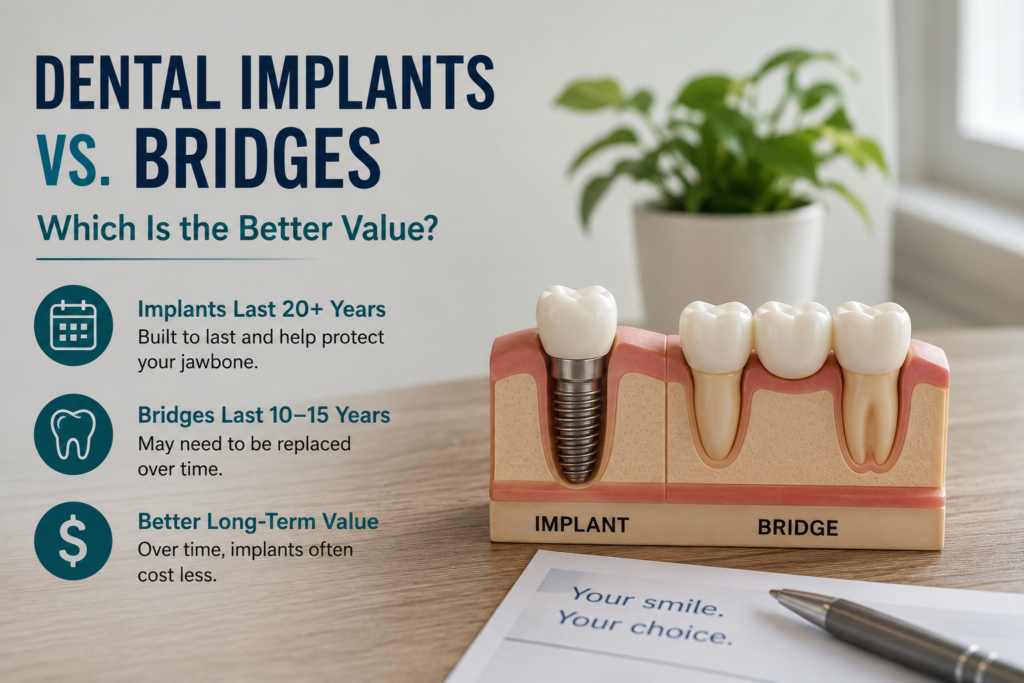
A bridge costs less upfront, but a dental implant is usually the better long-term value. Implants last 20 years or more and protect your jawbone, while bridges typically need replacing every 10 to 15 years. Over two decades, the implant often costs less once bridge replacements are counted. The best choice depends on your budget, bone health, and which tooth is missing.
Losing a tooth is stressful, and the next question is usually how to replace it. For most people in Beverly, the choice comes down to a dental implant or a bridge.
Both work well, but they differ in cost, lifespan, and what they ask of your other teeth. This guide breaks down the real numbers and trade-offs, with a Massachusetts angle, so you can decide with confidence.
Implants and Bridges: The Basics
What Is a Dental Implant?
A dental implant is a small titanium post placed in the jaw that acts like a natural tooth root, topped with a crown. Dental implants in Beverly stand on their own, so they do not rely on the neighboring teeth for support.
Because the post fuses to the bone, an implant is the only replacement that keeps the jawbone stimulated, the way a real root does.
What Is a Dental Bridge?
A bridge fills the gap with an artificial tooth held in place by crowns on the two teeth beside it. Those neighbors are filed down to anchor the crowns and bridges, which is a permanent change to otherwise healthy teeth.
A bridge sits on top of the gum rather than in the bone. It restores the look and function of the tooth, but it does nothing to preserve the bone underneath.
Dental Implant vs Bridge vs Denture: The Full Comparison
Here is how the three main tooth-replacement options stack up in 2026. These are national ranges, and Massachusetts often runs above the national average:
| Factor | Implant | Bridge | Partial Denture |
|---|---|---|---|
| Cost, one tooth | $3,000 to $6,000 | $2,000 to $5,000 | $1,000 to $3,000 |
| Lifespan | 20 to 25+ years | 10 to 15 years | 5 to 8 years |
| Procedure time | Months, with healing | 2 to 3 weeks | A few weeks |
| Surgery | Yes, minor | No | No |
| Pain level | Mild, few days | Minimal | None |
| Protects jawbone | Yes | No | No |
| Affects other teeth | No | Yes, files them down | Rests on them |
| Best candidate | Healthy bone and gums | Neighbors need crowns | Budget or many gaps |
Costs vary by case, materials, and any added procedures like bone grafting. Only an exam gives an accurate quote. Results vary from patient to patient.
Not sure which option fits your smile?
The team at Smiley Dental Beverly can assess your bite, bone, and budget and give you a clear estimate. Call 978-288-1000 or request an appointment online to talk it through.
Which Is Cheaper, an Implant or a Bridge?
Upfront, a bridge usually wins. A traditional three-unit bridge, which replaces one tooth using the two neighbors, runs about $2,000 to $5,000. A single implant, including the post, abutment, and crown, runs about $3,000 to $6,000.
But upfront price is only half the story. A bridge is what dentists call a wasting asset. Most need replacing every 10 to 15 years, so over a 20-year span you often pay for one twice. Counting one or two replacements, a bridge can total $4,000 to $10,000, which erases its early savings.
If you are replacing several adjacent teeth, an implant-supported bridge (anchored on implants rather than natural teeth) runs roughly $5,000 to $15,000 for a three-tooth span, and it avoids filing down healthy teeth. Weighed over the long run, dental implants in Massachusetts frequently come out as the lower lifetime cost.
How Long Do They Last?
Lifespan is where implants pull ahead, and the data backs it up.
The American Dental Association puts a well-maintained bridge at about 10 to 15 years. A systematic review of more than 4,000 conventional bridges found a 74 percent survival rate at 15 years, with decay on the anchor teeth a leading cause of failure. Implants last far longer: studies show roughly 90 to 95 percent still in place at 10 years, and many last 25 years or more, sometimes a lifetime.
The crown on top of an implant may need replacing after 15 to 20 years, but the post itself usually stays put. That durability is a big part of the value case.
Expert Tip
Ask about the hidden cost of a bridge: the anchor teeth. Filing down two healthy teeth makes them more prone to decay and fracture over the years, and if one fails, the whole bridge often has to be redone. If your neighboring teeth are perfectly healthy, that is a strong point in favor of an implant, which leaves them untouched.
What Is More Painful, a Bridge or an Implant?
This worries a lot of people, and the honest answer is that both are more comfortable than expected.
A bridge involves no surgery. The teeth are numbed, shaped, and fitted, so you feel pressure rather than pain, and there is little to no recovery. An implant does involve minor surgery to place the post, but it is done under local anesthesia, and most patients report only mild soreness for a few days afterward, managed with standard pain relief.
For anxious patients, sedation options make either procedure easy to sit through. If you have sensitive teeth or dental anxiety, tell the team ahead of time so they can keep you comfortable throughout.
Front Teeth: Does the Choice Change?
For a missing front tooth, appearance matters as much as function, and the gum line is less forgiving of mistakes.
An implant is often the preferred choice for a front tooth because it emerges from the gum like a natural tooth and does not put a dark line or extra bulk at the gum. It also avoids altering the highly visible teeth on either side. That said, a well-made bridge can look excellent too, especially when the neighboring teeth already need crowns.
Front-tooth work is as much art as science, which is why it falls under cosmetic dental treatment. Shade matching, gum contour, and shape all matter, so an experienced hand makes a real difference in the result.
Do Dentists Still Recommend Bridges?
Yes, in the right situations. Implants get most of the attention, but bridges remain a solid choice for many patients.
- The neighboring teeth already need crowns, so shaping them costs you nothing extra.
- You have low bone density and are not a candidate for an implant, or want to avoid a graft.
- You want a faster fix, since a bridge skips the months of implant healing.
- Budget is the deciding factor right now and the lower upfront cost matters most.
A good dentist recommends the option that fits your mouth and your life, not a one-size answer.
Quick Reference: Which Option Fits You?
Use this checklist to see which way you lean before your consultation:
- Want the longest-lasting result? An implant leads.
- Want to protect your jawbone? Only an implant does.
- Need the lowest upfront cost? A bridge or partial denture.
- Want to avoid surgery? A bridge or denture.
- Neighboring teeth already need crowns? A bridge makes sense.
- Replacing a front tooth for looks? An implant often wins.
- Have healthy teeth beside the gap? An implant keeps them untouched.
And yes, you can eat normally with a bridge once it settles, though very hard or sticky foods deserve care. An implant, once healed, handles food just like a natural tooth.
Insurance and Paying for Treatment in Massachusetts
Coverage often tips the math. Many dental plans treat a bridge as major restorative work and cover around 50 percent after your deductible, leaving roughly $500 to $1,500 out of pocket. Implants are frequently classed as elective or cosmetic, so coverage is smaller or absent. Check the specifics on our insurances accepted page.
Even when insurance favors the bridge upfront, remember the long-term math. If you are younger, the implant’s longer lifespan often makes it the better lifetime value despite the smaller insurance contribution. We help you weigh both the sticker price and the decades ahead.
Why Choose Smiley Dental Beverly
Our Beverly dental office at 45 Dodge Street plans and places implants and bridges in-house, and we give honest guidance on which fits your case. We serve Beverly, Danvers, Salem, Peabody, Wenham, Hamilton, and Ipswich.
- Experienced clinical team, including Dr. Nazia Pathan, a Boston University DMD with High Honors and an ICOI implant fellowship.
- Honest, upfront estimates, so you see both the initial and long-term cost before you decide.
- Modern technology, with 3D imaging for precise implant planning and findings reviewed on screen.
- Comfort-focused care, with sedation options for anxious patients.
Named among America’s Best Dentists, our team is here to help North Shore patients choose well. Call 978-288-1000 to book your consultation.
Frequently Asked Questions
A bridge is cheaper upfront, about $2,000 to $5,000 versus $3,000 to $6,000 for a single implant. But bridges usually need replacing every 10 to 15 years, so over 20 years the implant is often the lower total cost once replacements are counted.
An implant is often preferred for a front tooth, since it emerges from the gum like a natural tooth and does not require altering the visible teeth beside it. A well-made bridge can also look great, especially if those neighbors already need crowns. A consultation confirms the best look for your smile.
The American Dental Association puts a well-maintained bridge at about 10 to 15 years, though some last less depending on the type and your habits. Keeping the anchor teeth healthy with good brushing, flossing, and checkups helps a bridge reach the longer end of that range.
A bridge involves no surgery, so there is little discomfort beyond the numbing. An implant is minor surgery, done under local anesthesia, with mild soreness for a few days afterward that responds well to standard pain relief. Sedation options keep either procedure comfortable.
The biggest drawback is that it relies on filing down two healthy neighboring teeth, which makes them more prone to decay and fracture over time. A bridge also does not preserve the jawbone underneath, so the ridge can slowly flatten.
Yes, once it settles you can eat most foods comfortably. It is wise to go easy on very hard or sticky foods to protect the bridge and the anchor teeth. An implant, once fully healed, handles food just like a natural tooth.
The Bottom Line
For most people replacing a single tooth, a dental implant offers the best long-term value. It lasts longer, protects the jawbone, and leaves the neighboring teeth untouched. A bridge still makes sense when the budget is tight, when those neighbors already need crowns, or when you want to avoid surgery, and a partial denture is a lower-cost option for multiple gaps.
The right answer depends on your mouth, your goals, and your budget, which is exactly what a consultation sorts out. To compare your options and get an honest estimate for dental implants in Beverly or a bridge, call Smiley Dental Beverly at 978-288-1000 or request an appointment online. Find us at 45 Dodge St, Beverly.
Ready to replace that missing tooth?
Book a consultation at Smiley Dental Beverly to compare implants and bridges for your smile. Call 978-288-1000 or request an appointment online . New patients across the North Shore are always welcome.