Losing one or more teeth is common as we age, and choosing the right replacement can feel overwhelming. Dental implants and dentures are both effective options, but they work in different ways. Implants are fixed into the jaw and can offer strong stability and a natural feel, while dentures are removable and can replace several or all missing teeth without surgery. Implants usually take longer and cost more upfront, while dentures tend to be quicker and more affordable at first. The right choice depends on your oral health, bone support, budget, comfort, and personal goals, which is why a dental exam is the best starting point.
What Are Dental Implants?
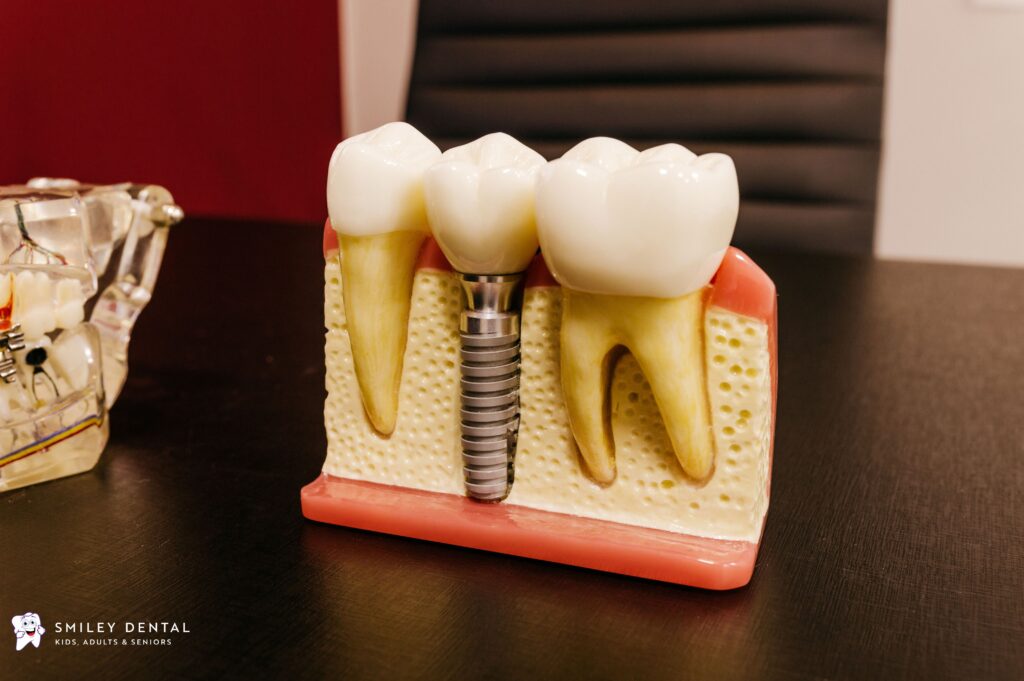
A dental implant is a small titanium post that a dentist places into the jawbone to act like an artificial tooth root. Once it has healed and joined with the bone, a custom dental crown is attached on top to look and function like a natural tooth.
Implants can replace a single missing tooth or several teeth in a row. When many teeth are missing, multiple implants can support a larger bridge or an implant-secured denture. For patients missing most or all of their teeth, full mouth dental implants may be an option.
Bone health matters because the jawbone needs to be strong enough to hold an implant securely. This is why a thorough evaluation, often including imaging, is an important first step before any dental implant treatment begins.
What Are Dentures?
Dentures are removable appliances that replace missing teeth. Full dentures replace an entire arch of teeth, while partial dentures fill in gaps when some natural teeth remain.
Dentures rest on the gums and are taken out daily for cleaning and while sleeping. They can help restore the ability to chew and can also improve the appearance of your smile. A good fit is essential, since the mouth can change shape over time as the jawbone reshapes itself, which means dentures may need periodic adjustment.
Dental Implants vs Dentures: A Simple Comparison
Here is a simple side-by-side look at how the two options generally compare:
Dental Implants
- Fixed in place and generally very stable
- Designed to look and feel like natural teeth
- Often provide strong, reliable chewing function
- Require a surgical procedure and a healing period
- Usually involve a longer overall treatment timeline
- Generally have a higher initial cost
- Cleaned by brushing like natural teeth, along with regular professional care
- Can last many years with proper care and maintenance
- Implant placement can help support the jawbone in that area
Dentures
- Removable and may shift slightly depending on fit
- Can provide a natural-looking smile
- Chewing ability can vary and may take practice
- Do not require implant surgery
- Often completed on a shorter timeline
- Generally have a lower initial cost
- Must be removed and cleaned on a regular schedule
- May need adjustment, repair, or eventual replacement
- Do not stimulate the jawbone the way an implant does
Every patient’s situation is different, so these points are general guidelines rather than guarantees.
Pros of Dental Implants for Seniors
Dental implants offer several potential benefits for older adults who are good candidates:
- Strong, fixed stability with no slipping
- A natural-looking appearance
- No need to remove the replacement teeth at night
- Easier chewing for many patients
- Ability to replace one tooth without altering neighboring teeth
- Can be used to support an implant-secured denture
- Potential long-term value with proper care
- May help maintain bone in the area where the implant is placed
Whether implants are right for you depends on an evaluation of your oral and overall health.
Cons of Dental Implants for Seniors
There are also some real considerations to weigh:
- Higher initial cost compared to dentures
- Requires a surgical procedure
- Longer overall treatment timeline
- A healing period is needed before the final crown is placed
- Bone grafting may be needed if there isn’t enough bone
- Not every patient is a candidate
- Careful oral hygiene is needed to protect the implant long term
- Certain health conditions or medications may affect the treatment plan
- Smoking can affect healing and implant success
Age by itself does not rule someone out of implant treatment. These other health factors matter more.
Pros of Dentures for Seniors
Dentures remain a practical and widely used option for many reasons:
- Lower initial cost in many cases
- No implant surgery required
- Can replace many missing teeth at once
- A practical choice for patients who are not implant candidates
- Can restore appearance and a good amount of chewing function
- Treatment is often completed faster than implants
Cons of Dentures for Seniors
Dentures also come with some trade-offs to keep in mind:
- May move or slip while eating or speaking
- Often require an adjustment period to get used to
- Need regular daily cleaning
- Must usually be removed for cleaning and while sleeping
- May need periodic adjustments as the mouth changes
- Jawbone changes over time can affect how well they fit
- Some foods may be harder to chew
- May need repair or replacement after several years
Should a 70-Year-Old Get Dental Implants?
Yes, 70 is not automatically too old for dental implants. Age alone is not the deciding factor. What matters more is:
- Overall health
- Gum health
- Jawbone volume and quality
- How well the body heals
- Current medications
- Smoking status
- Existing medical conditions
- Ability to keep up with oral hygiene
- Personal expectations and treatment goals
A dentist should evaluate each patient individually rather than basing the decision on age alone. Many older adults are excellent implant candidates.
At What Age Should You Not Consider Dental Implants?
There is no universal age cutoff for dental implants. The decision is based on a patient’s health, oral condition, bone support, healing ability, and commitment to maintaining the implant, not on a number. An older adult can still be a good candidate if their dentist determines the treatment is appropriate for their specific situation.
Dentures vs Implants Cost: Which Costs More?
Dental implants generally have a higher initial cost than dentures. Several factors can affect implant pricing, including the number of implants needed, whether bone grafting is required, the type of restoration used, whether you choose individual implants or an implant-supported denture, and any diagnostic imaging or additional procedures.
Denture costs can vary based on whether you need a partial or full denture, the materials used, the number of teeth being replaced, and future adjustments or repairs.
While dentures may cost less upfront, it helps to think about long-term maintenance, potential replacements, comfort, and daily function, not just the starting price. Our patient financing options can help make either treatment more manageable.
Snap-In Dentures vs Traditional Dentures
Snap-in dentures, also called implant-supported dentures, use a small number of dental implants to hold a removable denture more securely in place. They still come out for cleaning like traditional dentures, but they attach to the implants for added stability.
Compared to traditional dentures, snap-in dentures generally offer better stability and can improve chewing confidence. They do require implant placement first, which adds to treatment time and cost, but many patients feel the added security is worth it. Traditional dentures remain a good option for patients who prefer to avoid surgery altogether.
Dental Implant vs Denture for One Tooth
A single missing tooth can typically be replaced with a dental implant and crown, a dental bridge, or a partial denture.
A dental implant replaces the tooth root directly and does not rely on neighboring teeth for support, which can help protect those teeth over time. A bridge uses the teeth on either side of the gap for support, and a partial denture is removable. Implants generally take longer to complete but can offer strong, long-lasting stability for that one tooth.
Implant vs Denture vs Bridge: Which Is Better?
Each option serves a different purpose. A dental implant provides a fixed replacement but requires surgery and healing time. A denture offers a removable option for replacing several or all missing teeth, though it needs regular maintenance and may shift. A dental bridge can replace one or a few adjacent missing teeth by using the neighboring teeth for support. There is no single best option for every patient. The right choice depends on your specific needs.
Pros and Cons of Full Dental Implants
Full-mouth or full-arch implant treatment replaces an entire row of missing teeth using a series of implants that support a fixed bridge.
Potential benefits include a fixed replacement, strong stability, a natural-looking appearance, and an alternative to traditional removable dentures. Considerations include a higher treatment cost, surgical procedures, healing time, adequate bone requirements, and more complex treatment planning. Ongoing maintenance is still necessary afterward. Full dental implants are not automatically the right fit for every senior, which is why a personalized evaluation matters.
What Is the Best Option for Missing Teeth Replacement?
The best option depends on the number and location of missing teeth, gum health, bone support, overall health, budget, desired appearance, comfort preferences, and how easily you can maintain good oral hygiene.
As a general guide:
- One missing tooth: An implant, bridge, or partial denture may be considered.
- Several missing teeth: A partial denture, bridge, or implant-supported restoration may be considered.
- Most or all teeth missing: Full dentures, implant-supported dentures, or full-mouth implant treatment may be considered.
Questions Seniors Should Ask Before Choosing Implants or Dentures
- How many teeth do I need to replace?
- Is my gum health good enough for treatment?
- Do I have enough bone for dental implants?
- Would I need a bone graft?
- How long will treatment take?
- What will the treatment actually involve?
- What maintenance will I need afterward?
- What are my payment or financing options?
- What option fits my daily lifestyle?
- What are the long-term costs of each option?
Signs Dental Implants May Be Worth Discussing
- You want a fixed tooth replacement
- You have one or more missing teeth
- You want improved stability while eating and speaking
- You want to avoid a removable denture
- Your oral health can support implant treatment
- You are willing to go through a longer treatment process
- You understand that implants require ongoing care
- You want to explore long-term tooth replacement options
Not Sure Whether Implants or Dentures Are Right for You?
Every patient’s situation is different. The number of missing teeth, gum health, bone support, overall health, budget, and personal preferences can all affect which option makes the most sense. A dental evaluation can help determine which tooth replacement options are appropriate for your smile and your goals.
How to Choose Between Dental Implants and Dentures
- Start with a dental evaluation. This helps determine the condition of your teeth, gums, and jawbone.
- Identify how many teeth are missing. Treatment for one missing tooth looks very different from treatment for an entire arch.
- Discuss your health history. Certain medications and health conditions may affect treatment planning.
- Compare treatment timelines. Dentures are often completed sooner, while implants generally involve additional treatment and healing.
- Compare the full cost. Look at both the initial investment and the long-term expenses.
- Think about daily comfort. Consider whether you prefer a removable or fixed replacement.
- Consider maintenance. Understand what daily and professional care each option will require.
Why Choose Smiley Dental Beverly?
At Smiley Dental Beverly, we take the time to understand each patient’s oral health, goals, and budget before recommending a treatment path. Whether you’re exploring dental implant consultations, comparing tooth replacement options, or trying to understand your financing choices, our team focuses on personalized, patient-centered care. We offer comprehensive dental evaluations and support patients at every stage of tooth loss, helping you feel confident in whichever treatment you choose.
Frequently Asked Questions
Should a 70-year-old get dental implants?
Age alone does not rule someone out. Many people in their 70s and beyond are good candidates for implants, depending on their overall health, bone support, and healing ability.
What is the best option for missing teeth replacement?
It depends on how many teeth are missing, your oral health, bone support, and personal preferences. A dental evaluation can help identify the most appropriate option for you.
At what age should you not consider dental implants?
There is no set age limit. The decision is based on a person’s health and oral condition rather than age alone.
Are dentures or implants better for elderly patients?
Neither is universally better. Implants offer more stability and a fixed feel, while dentures are removable and may be more accessible for patients who are not implant candidates.
Are dental implants more expensive than dentures?
Implants generally have a higher initial cost due to the surgical procedure and materials involved, while dentures tend to have a lower upfront cost.
What are the pros and cons of dental implants for seniors?
Implants offer stability, a natural look, and no need for nightly removal, but they involve surgery, healing time, and a higher initial cost.
What are the pros and cons of dentures for seniors?
Dentures are more affordable upfront and do not require surgery, but they can shift, need regular cleaning, and may require future adjustments.
Are snap-in dentures better than traditional dentures?
Snap-in dentures generally offer more stability because they are supported by implants, but they involve implant placement first. Traditional dentures avoid surgery altogether.
Is an implant or denture better for one missing tooth?
An implant can replace a single tooth without relying on neighboring teeth, while a partial denture is a removable, non-surgical alternative. Both are worth discussing with your dentist.
Can seniors get full-mouth dental implants?
Many seniors are candidates for full-mouth implants, but suitability depends on bone support, overall health, and a thorough evaluation.
Final Thoughts
Both dental implants and dentures are effective ways to replace missing teeth, and each comes with its own set of benefits and trade-offs. Implants provide fixed stability but usually involve surgery, healing time, and a higher initial investment. Dentures are removable and can be a more accessible option for many patients, and snap-in dentures offer a middle ground for those who want extra support without full implant treatment.
There is no single best option for every senior, and age alone should never be the deciding factor. The right choice comes down to your oral health, bone support, budget, and personal comfort. If you’re ready to explore your options, schedule an appointment or contact our team at Smiley Dental Beverly to discuss the best tooth replacement plan for your smile.