
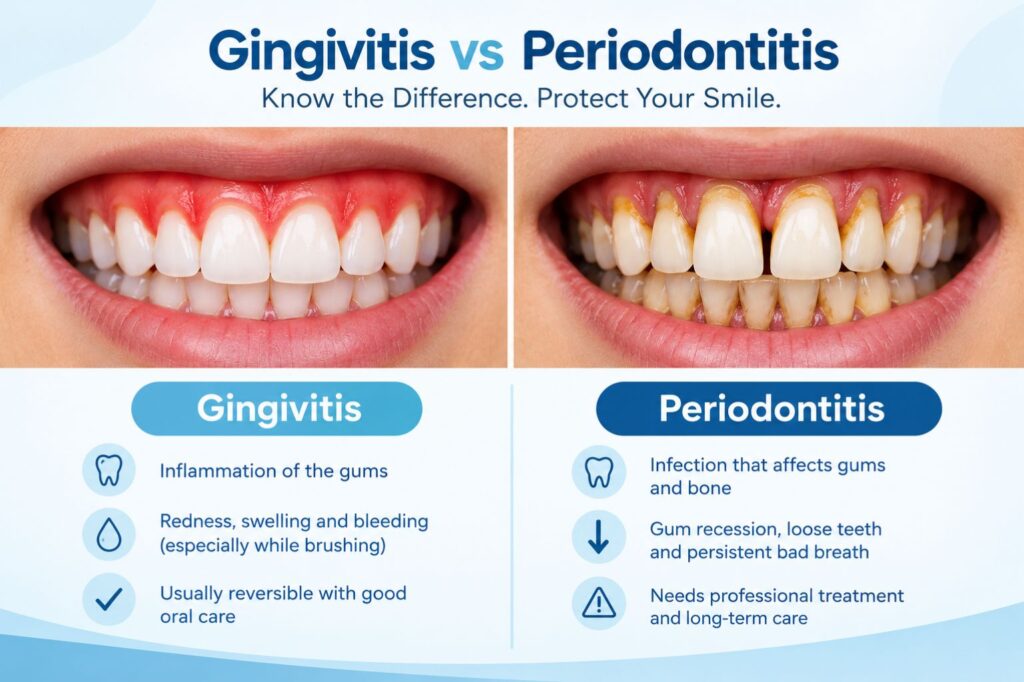
Gingivitis and periodontitis are often used interchangeably, but they describe two very different conditions. Gingivitis affects only the gums and is generally reversible with better oral hygiene and professional cleaning. Periodontitis is a more advanced disease that damages the tissue and bone that hold your teeth in place, and once that damage occurs, it cannot simply be brushed away. When periodontitis is diagnosed, dentists classify it into four stages, from Stage I to Stage IV, based on how much damage has occurred and how complex the case is to treat. Symptoms alone cannot tell you which stage you’re in. Only a dental examination can determine that.
Quick Answer: Gingivitis is inflammation of the gums that can often be reversed with improved oral hygiene and professional dental care. Periodontitis is a more advanced form of gum disease that damages the tissues and bone supporting the teeth. When periodontitis is present, dentists classify it from Stage I to Stage IV based on attachment loss, bone loss, tooth loss, and case complexity. Symptoms alone cannot determine the stage.
Gingivitis vs Periodontitis: What Is the Difference?
The easiest way to think about the difference is this: gingivitis stays at the surface, while periodontitis goes deeper.
Gingivitis involves:
- Inflammation limited to the gum tissue
- Redness or swelling along the gumline
- Bleeding when brushing or flossing, which may or may not be noticeable
- No destruction of the bone that supports the teeth
- A condition that can generally be reversed with proper care
Periodontitis involves:
- A chronic inflammatory condition affecting the tissues that support the teeth
- Possible formation of periodontal pockets, which are spaces that open up between the tooth and gum
- Loss of attachment and supporting bone
- Tooth mobility or tooth loss in more advanced cases
- A condition that can be treated and managed, but not reversed through brushing alone
| Feature | Gingivitis | Periodontitis |
| Main area affected | Gums | Gums and supporting tissues |
| Common signs | Red, swollen, bleeding gums | Bleeding, recession, pockets, possible loose teeth |
| Bone loss | Not characteristic | Characteristic feature |
| Attachment loss | Not characteristic | Present |
| Reversible | Generally yes | Existing damage is not fully reversible |
| Professional assessment | Recommended | Necessary for diagnosis and staging |
Not every patient will experience every symptom listed here, and the presence of one symptom does not automatically confirm a diagnosis either way.
How Does Gingivitis Progress to Periodontitis?
Gum disease typically develops in a sequence. Plaque builds up along the gumline, which leads to gum inflammation. If that inflammation isn’t addressed, it can become persistent, and plaque that isn’t removed can harden into a substance called calculus, or tartar, which brushing and flossing can no longer remove on their own. Over time, this persistent buildup can contribute to the formation of periodontal pockets, damage to the attachment between the tooth and gum, and eventually loss of the bone that supports the tooth. That combination of pocket formation, attachment loss, and bone loss is what defines periodontitis.
It’s important to understand that untreated gingivitis does not automatically turn into periodontitis for everyone. Progression varies from person to person, and certain factors can raise the risk. The CDC identifies smoking, diabetes, and poor oral hygiene, among other factors, as associated with gum disease. Genetics and certain medications can also play a role in how someone’s gums respond to plaque over time.
How to Know if Gingivitis Has Progressed to Periodontitis?
There’s no single symptom that confirms progression on its own, but certain changes are worth paying attention to. These include:
- Gum bleeding that continues even after improving your brushing habits
- Gums that appear to be pulling away from the teeth
- Visible gum recession
- A sense that there are deeper spaces or pockets forming around certain teeth
- Teeth that feel loose or seem to be shifting position
- Pain or discomfort when chewing
- Bad breath that doesn’t go away with brushing
- A noticeable change in how your upper and lower teeth meet when you bite down
These signs may suggest that an evaluation is needed, but they don’t tell you what stage the disease has reached. It’s also worth knowing that periodontal disease can be present without any obvious symptoms at all, which is one reason routine dental visits matter even when your mouth feels fine.
What Are the Stages of Periodontitis?
Once periodontitis is diagnosed, it is classified using a system developed jointly by the American Academy of Periodontology and the European Federation of Periodontology. This framework looks at both severity, meaning how much damage has already occurred, and complexity, meaning how difficult the case will be to manage. Measurements used in this assessment include clinical attachment loss, bone loss visible on X-rays, tooth loss caused by periodontitis, probing depth, and additional factors such as furcation involvement and tooth mobility.
What Does Stage 1 Periodontitis Look Like?
Stage I is considered initial periodontitis. It generally involves interdental clinical attachment loss of roughly 1 to 2 millimeters, bone loss on X-rays limited to the upper third of the root and under about 15 percent, and no tooth loss caused by periodontitis. Complexity at this stage is typically lower than in later stages.
Stage I often doesn’t come with dramatic visible changes. A patient might notice occasional bleeding or slight gum changes, but appearance alone cannot confirm this stage. It takes clinical measurements and imaging to identify it accurately, which is why an at-home assessment isn’t reliable here.
What Is Stage 2 Periodontitis?
Stage II represents moderate periodontitis. It’s generally associated with interdental clinical attachment loss of about 3 to 4 millimeters, bone loss in the coronal third of the root ranging from roughly 15 to 33 percent, and still no tooth loss attributable to periodontitis. Complexity is greater than Stage I, and probing depths as part of the overall picture may reach the moderate range. As with Stage I, the full classification depends on a complete periodontal assessment rather than any single measurement taken on its own.
Can Stage 2 Periodontal Disease Be Stopped?
Stage II periodontitis can often be treated and managed effectively. Treatment is generally aimed at controlling inflammation, reducing the periodontal infection, stabilizing the condition, and preventing it from advancing further. That said, treatment isn’t a guaranteed cure in the sense of undoing bone loss that has already happened. The realistic goal is disease control and long-term maintenance.
Depending on the individual case, treatment may involve a professional periodontal evaluation, guidance on plaque control at home, scaling and root planing (a deeper cleaning below the gumline), ongoing periodontal maintenance visits, and management of contributing risk factors like smoking. In some situations, additional periodontal treatment may be recommended. Learn more about what this process involves on our periodontal therapy page.
What Are Stage 3 and Stage 4 Periodontitis?
Stage III involves clinical attachment loss of 5 millimeters or more and bone loss reaching the middle third of the root or beyond. Up to four teeth may have been lost to periodontitis, and complexity factors like deeper probing depths, vertical bone defects, or furcation involvement (bone loss where the roots of a multi-rooted tooth branch apart) are often part of the picture.
Stage IV shares the same attachment loss and bone loss criteria as Stage III but involves greater complexity: five or more teeth lost to periodontitis, along with issues like tooth drifting, bite collapse, or fewer functional back teeth remaining to chew with comfortably.
These later stages are defined by increasing severity, documented tooth loss, and greater management complexity, not by a guarantee that every patient will lose their teeth.
How Do I Know What Stage My Periodontal Disease Is?
This isn’t something you can determine on your own, and that’s by design. Staging periodontitis requires a professional evaluation that typically includes the following:
- Periodontal probing. A dentist or hygienist gently measures the depth of the space between your gum and tooth at several points around each tooth.
- Clinical attachment measurements. These help identify how much attachment loss has occurred, which is a key factor in staging.
- Dental X-rays. Radiographs allow your dentist to see bone levels that aren’t visible during a visual exam.
- Review of tooth loss history. Your dentist determines whether any missing teeth were lost specifically because of periodontitis.
- Complexity assessment. This includes factors such as pocket depth patterns, bone loss shape, furcation involvement, tooth mobility, and functional concerns.
If you’d like to understand what this kind of visit involves in more detail, our comprehensive dental exam guide walks through the process.
What Is the Difference Between Periodontal Stage and Grade?
Stage and grade sound similar, but they measure different things entirely. Stage describes how severe the disease is right now and how complex it will be to treat. Grade adds a separate layer of information, describing how quickly the disease is likely to progress and what risk factors might affect that progression or how well someone responds to treatment.
Grading uses categories labeled Grade A, Grade B, and Grade C. It would be inaccurate to call Grade A “mild” or to treat Grade C as the same thing as Stage III. A person could, for example, have Stage II disease with a Grade C progression pattern, meaning the damage isn’t extensive yet, but it’s moving faster than typical and may need closer monitoring.
What Are the Signs of Gingivitis?
Gingivitis tends to show up as:
- Red or darker pink gums compared to healthy tissue
- Swelling along the gumline
- Tenderness when touched
- Bleeding during brushing or flossing
- Visible plaque buildup near the gumline
- Occasional bad breath
Since gingivitis is primarily an inflammatory response and doesn’t involve destruction of the supporting bone, these symptoms often improve once plaque is properly managed.
What Are the Signs of Periodontitis?
Periodontitis can present with:
- Gum inflammation or bleeding that persists over time
- Gum recession, where the gumline appears to move down the tooth
- Periodontal pockets that a dentist can measure during an exam
- Teeth that feel loose or have shifted
- A change in how the bite feels
- Discomfort while chewing
- Bone loss, which is typically identified through X-rays
- Ongoing bad breath
- Tooth loss in more advanced cases
Not every patient experiences every item on this list, and some people with periodontitis notice very few symptoms at all.
Can Gingivitis Be Reversed?
Yes, in most cases plaque-related gingivitis can be reversed with consistent care. This generally includes brushing twice a day, cleaning between your teeth daily, keeping up with professional dental cleanings, and having any hardened tartar removed by a hygienist. If something else is contributing to the inflammation, such as a medication side effect or a hormonal factor, that may need to be addressed too. Home care helps, but it isn’t always sufficient on its own for every patient, which is why professional cleanings remain an important part of the process. Our dental cleaning page has more on what these visits typically involve.
Can Periodontitis Be Reversed?
This is where the distinction from gingivitis matters most. Periodontitis can be treated and controlled, but the bone and attachment loss that has already occurred cannot simply be reversed by brushing and flossing better. Treatment instead focuses on controlling the active disease, reducing inflammation, stabilizing the supporting tissues, and preventing further damage from occurring.
There’s a difference between improving gum health and reversing structural damage. Some regenerative procedures exist that aim to rebuild lost bone or tissue in specific situations, but these are not guaranteed outcomes and aren’t appropriate for every case.
Gingivitis vs Periodontitis Treatment
Treatment approaches differ based on which condition is present and how advanced it is.
For gingivitis, care usually centers on better daily plaque control, a professional cleaning, refining your brushing and interdental cleaning technique, and keeping up with regular checkups.
For periodontitis, treatment may include a periodontal evaluation, scaling and root planing, periodontal maintenance visits scheduled more frequently than a standard cleaning, medication in select cases, and periodontal surgery or other advanced procedures when clinically appropriate. There isn’t one universal “best” treatment. What works depends on the extent of the disease and the individual patient.
Is Periodontal Disease Always Painful?
No. Gum disease, including periodontitis, can be present without causing significant pain. This is actually one of the reasons routine dental exams matter so much, since a patient can have meaningful bone loss without feeling anything unusual day to day. Pain shouldn’t be used as the main way to judge whether gingivitis or periodontitis is present.
When Should You See a Dentist About Bleeding Gums?
Occasional bleeding, especially if you’ve recently started flossing again or changed your toothbrush, isn’t automatically a sign of periodontitis. But bleeding that keeps happening or comes back regularly is worth having evaluated, particularly if it’s paired with swelling, gum recession, persistent bad breath, loose teeth, pain while chewing, or a change in your bite. If you’re dealing with any of these together, scheduling an evaluation is a reasonable next step. Our preventive dental care page covers how routine visits help catch these changes early.
Gum Disease Evaluation in Beverly, MA
If you live in or around Beverly, MA and you’re noticing changes in your gums, an evaluation at Smiley Dental Beverly can help determine whether what you’re experiencing is more consistent with gingivitis or whether further periodontal assessment is needed. A thorough exam, along with any necessary imaging, gives a clearer picture than symptoms alone ever could, and it allows your dentist to put together a treatment plan suited to your specific situation.
Smiley Dental Beverly
45 Dodge St, Beverly, MA 01915
Frequently Asked Questions
Gingivitis is inflammation limited to the gum tissue and is generally reversible. Periodontitis is a more advanced condition that damages the attachment and bone supporting the teeth, and that damage cannot simply be reversed through home care alone.
Watch for persistent bleeding, gum recession, loose teeth, pain while chewing, or changes in your bite. These signs suggest an evaluation is needed, but only a dental exam can confirm whether periodontitis is present.
Stage I periodontitis often has few noticeable symptoms. It’s identified through clinical attachment measurements and early bone loss on X-rays rather than through appearance alone.
Stage II periodontitis can often be treated and managed through scaling and root planing, ongoing maintenance, and risk factor control, though existing bone loss won’t fully reverse.
Staging requires a professional evaluation including periodontal probing, clinical attachment measurements, X-rays, and a review of tooth loss history and case complexity.
Yes, plaque-related gingivitis generally responds well to improved daily oral hygiene combined with professional cleanings to remove hardened tartar.
Periodontitis can be treated and controlled, but bone and attachment loss that has already occurred cannot simply be reversed through brushing and flossing alone.
Advanced periodontitis may involve significant bone and attachment loss, tooth mobility, changes in bite alignment, and in some cases tooth loss, along with greater treatment complexity.
No. Periodontitis can progress without noticeable pain, which is why routine dental checkups are important even when your mouth feels fine.
Diagnosis typically involves periodontal probing, a review of your dental and medical history, a visual examination of the gums and teeth, and X-rays to assess bone levels.
The Bottom Line
Have bleeding, swollen, or receding gums? A dental evaluation can help determine whether you have gingivitis or signs of periodontal disease. Contact Smiley Dental Beverly to schedule an examination.