
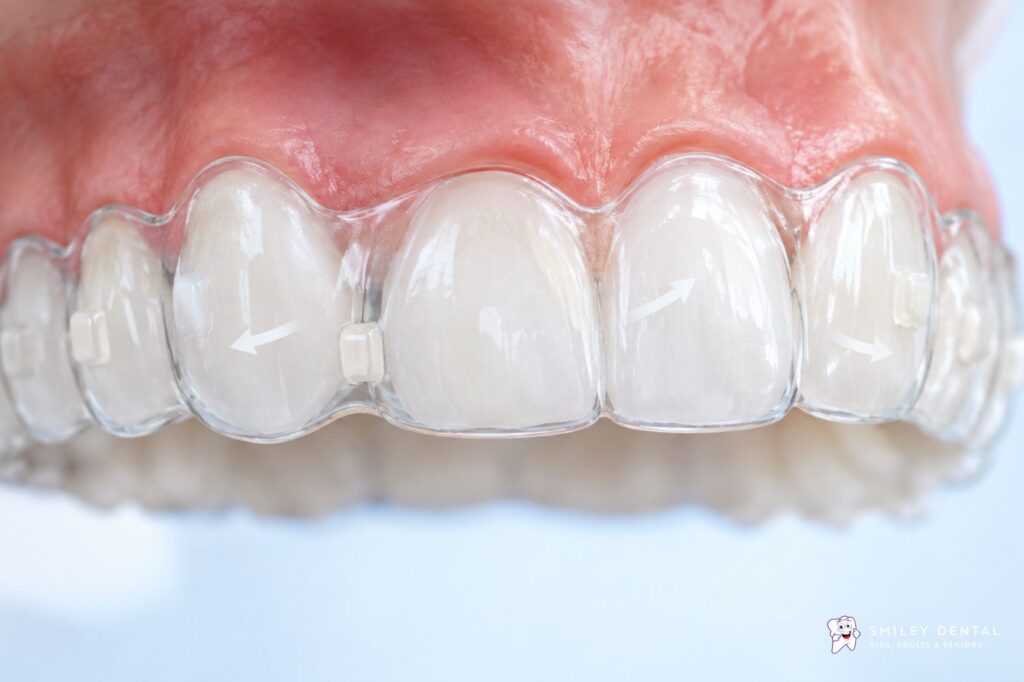
Transparent aligners move teeth by applying gentle, controlled pressure to specific teeth. Each aligner is shaped a little differently from the one before it, so it nudges selected teeth toward a planned position. As you wear it, the tissues that support your teeth slowly remodel, which allows the tooth to shift. The next aligner in the series continues the process. When a tooth needs extra control, your dentist may bond a small tooth-colored attachment to it. No metal brackets or wires are involved.
Quick Answer
Clear aligners do not need wires because wires are only one way to deliver orthodontic force. An aligner is a custom-shaped tray that fits closely over your teeth. Where the tray’s shape differs from a tooth’s current position, it applies light pressure in that direction. Your body responds to that steady pressure by gradually rebuilding the bone around the tooth. How well this works depends on your case, your treatment plan, and how consistently you wear the aligners.
How Can a Thin Piece of Plastic Move a Tooth?
Here is the part most people find surprising: the plastic itself is not what moves your teeth. The shape of the aligner is.
Think of pressing a foam insert into a slightly different mold. The insert wants to sit where the mold is shaped, and it pushes against anything in the way. An aligner works in a similar spirit. It is made to match a position just a small step away from where your tooth sits today. When you snap it on, the tray applies light force to bring the tooth toward that shape.
That force is deliberately small. Orthodontic movement works best with gentle, steady pressure, not hard pushing. This is also why you may feel mild tightness when you begin a new aligner, and why your dentist plans the movement in small stages.
Braces and Aligners: Two Ways to Deliver the Same Force
Traditional braces use brackets bonded to the teeth, with wires and other small components connecting them. The wire carries the force.
Clear aligners use a different delivery system:
- A custom-shaped tray that contacts the tooth surfaces
- A planned distribution of force across selected teeth
- Attachments on some teeth, when extra control is needed
The key idea is that tooth movement needs controlled force, not necessarily metal wires. Both approaches depend on the same underlying biology. They differ in how the force is delivered and controlled.
What Happens Inside Your Mouth When a Tooth Moves
Your teeth are not fused directly to your jawbone. Each tooth sits in a socket and is held by a thin, elastic tissue called the periodontal ligament. It acts like a cushion between the tooth and the bone.
When an aligner presses on a tooth, the following happens:
- The ligament is slightly compressed on the side the tooth is moving toward.
- The ligament is slightly stretched on the opposite side.
- Cells in the surrounding bone respond to those changes. Bone is gradually broken down where there is pressure and built up where there is tension.
- Over time, the tooth settles into its new position..
So a tooth is not simply pushed through solid bone. The bone around it is remodeled in response to gentle force, and that takes time. This is the main reason aligner treatment happens in stages, and why rushing the schedule is not a good idea.
Why One Aligner Is Never Enough
A clear aligner treatment does not usually move every tooth into its final position with a single tray. Each aligner is one step in a planned sequence.
Picture climbing a staircase. You do not leap to the top floor. You take one step at a time, and each step is small enough to be manageable. Aligners work the same way. Each tray asks the teeth to move a small amount, and your dentist chooses that amount based on what the teeth can comfortably handle.
For that reason, the number of aligners varies from person to person. A case with minor changes may need fewer trays than one involving more movement. Your dentist will give you a plan for your own teeth.
How Aligner Treatment Works Step by Step
Here is what the process often looks like, although the details vary by provider and case.
1. Examination. Your dentist reviews your teeth, gums, bite, and treatment goals. Oral health comes first, since teeth and gums should be healthy before movement begins.
2. Treatment planning. Digital scans or other records are used to map out the planned movements. Many systems let you preview the intended sequence.
3. Custom aligners. A series of trays is made according to that plan.
4. Wearing the first aligner. You start the series and follow the wear instructions you are given.
5. Gradual movement. Each aligner applies pressure to selected teeth over the period it is worn.
6. Moving to the next aligner. You progress through the sequence as directed by your provider.
7. Monitoring. Your dentist checks whether your teeth are tracking, meaning following the planned movement.
8. Refinement, if needed. Additional aligners may be prescribed if the teeth need further adjustment.
9. Retention. After active treatment, retainers are usually recommended to help keep teeth in their new positions.
A quick note on terms. “Clear aligners” or “transparent aligners” describe a type of treatment. Invisalign is one specific clear aligner system and brand. Other clear aligner options exist, and this article uses the general terms unless it is talking about Invisalign specifically. To see how the Invisalign system fits into care at our practice, you can read about Invisalign clear braces.
Attachments: The Small Bumps That Help Aligners Grip
Attachments are small, tooth-colored shapes bonded to selected teeth. The aligner is designed to fit around them, and this gives it something to press against.
Can Invisalign work without attachments? Yes, some movements can happen without them. Many treatment plans do include attachments on certain teeth, though, because they can help the aligner grip and direct force more predictably.
Attachments may be especially helpful for:
- Rotating a tooth that sits turned in its spot
- Certain up-and-down movements
- Moving a tooth in a specific direction
- More complex movements that need extra control
Not every patient needs them, and not every tooth in the mouth gets one. Your dentist decides where they belong based on your plan. They are removed at the end of treatment, and your tooth surface is polished afterward.
Which Tooth Movements Can Aligners Handle?
Aligners can guide many kinds of movement, but predictability differs from one type to another. Here are the ones patients ask about most.
Crowded teeth
Aligners can address some cases of crowding by creating space and repositioning teeth. Your dentist may widen the arch slightly or, when clinically appropriate, smooth away a very small fraction of a millimeter of enamel between teeth (a step called interproximal reduction) to make room. This is a small, carefully controlled adjustment, and your dentist will explain whether it is needed in your case. Mild to moderate crowding is often more straightforward than severe crowding, and the right approach depends on how much room is needed.
Gaps between teeth
Aligners can close some gaps. Before doing so, your dentist will look at why the gap exists. The size of the space, the position of the teeth, your bite, and your gum health all matter. A gap should not simply be closed without understanding its cause.
Rotated teeth
Rotation can be one of the trickier movements. Results depend on tooth shape, how much rotation is needed, and how well the aligner fits. Teeth with rounder or conical shapes, like certain premolars, can be harder for plastic trays to grip and turn, which is why attachments often play a role here.
Front teeth versus back teeth
Incisors, canines, premolars, and molars all respond differently. Aligners can move many types of teeth, but some movements are easier to control than others. More complex movements may call for attachments, extra aligners, or a different orthodontic approach altogether.
An aligner can only apply force while it is in your mouth. Because tooth movement builds up gradually, consistent wear keeps the process on track.
Invisalign’s provider guidance commonly describes wearing aligners for roughly 20 to 22 hours a day, removing them for eating, drinking anything other than plain water, and cleaning. Your own instructions may differ, so follow the schedule your dentist gives you.
What about the “30 minute rule”? You may see this mentioned online. It generally refers to the idea that aligners should not stay out for long stretches, for example after a meal. It is a helpful reminder, but it is not a universal clinical rule. The exact guidance depends on your provider and your aligner system. The practical principle is simple: the longer your aligners stay out, the less consistent your treatment schedule becomes. Follow your dentist’s instructions, and put your aligners back in as soon as you reasonably can.
What if you do not wear them enough? Nothing dramatic happens after one long day out. Over time, though, inconsistent wear can lead to:
- Teeth not tracking with the planned aligner
- An aligner that feels tight or does not seat fully
- Treatment taking longer
- Extra aligners or a revised plan
If a new aligner does not fit properly, contact your dentist. Please do not force it in, and do not skip ahead in the series on your own.
How Long Does Treatment Take?
There is no single answer. Treatment time depends on:
- How many teeth are being moved
- How far they need to travel
- Whether your bite needs correction
- How consistently you wear the aligners
- How your teeth respond
- Whether refinements are needed
- Your oral health and treatment goals.
Some cases are shorter and others take considerably longer. Your dentist can give you an estimate after evaluating your teeth, but an estimate is not a guarantee.
Why “Failure” Can Be a Misleading Word
People often search for the failure rate of Invisalign. Unfortunately, there is no single, standardized number that answers this, and any one percentage presented as a universal rate should be treated with caution.
That is because “failure” can mean very different things. A patient might feel treatment did not work if:
- A tooth did not track as planned
- Treatment took longer than expected
- Refinement aligners were needed
- The final result differed from the original plan
- Wear was inconsistent
- The plan had to be changed
Needing refinement aligners does not automatically mean treatment failed. Refinements are a normal, common part of many aligner treatments. They are simply additional trays used when more movement is needed after the first series.
Outcomes depend on case complexity, treatment planning, wear time, oral health, the amount of movement required, aligner fit, and follow-up care. If you come across a specific statistic, check the original study, who was included, and how it defined success.
Why Isn’t My Tooth Moving? A Quick Checklist
If a tooth seems stuck, that does not automatically mean you did something wrong. Possible reasons include:
- Wear time: Aligners were out longer than planned
- Fit: The tray is not seating fully
- Tooth shape: Some teeth are simply harder to grip
- Type of movement: Rotations and certain vertical movements can be less predictable
- Attachments: The attachment design or placement may need adjusting
- Biology: Every person’s bone and tissue respond a little differently
- Planning: The plan may need to be modified
If your teeth are not moving as planned, your dentist may check the fit, review how your teeth are tracking, adjust attachments, discuss refinement aligners, or, if clinically appropriate, talk about a different approach. Please avoid changing your aligner sequence without guidance.
Why Would a Dentist Recommend Braces Instead?
Some patients hear that “dentists do not recommend Invisalign.” That is not really the full picture. Many dentists and orthodontists use clear aligners regularly. A recommendation for braces simply reflects what may work best for a particular case. Braces may be suggested when:
- The required tooth movement is complex or extensive
- Significant rotations are needed
- The bite needs a type of correction that calls for different mechanics
- Patient compliance may be a concern
- Braces may offer more predictable control for that specific situation
A recommendation for braces does not mean aligners are ineffective. It means the treatment plan should fit your teeth, bite, and goals.
Clear Aligners vs Traditional Braces
Both can move teeth. They just use different mechanics, and neither is universally better.
| Factor | Clear Aligners | Traditional Braces |
| Appliance | Removable trays | Fixed brackets and wires |
| Appearance | Generally less noticeable | More visible |
| How force is delivered | Aligner shape and attachments | Wires, brackets, and other components |
| Removable | Yes | No |
| Patient compliance | Very important | Less dependent on the patient |
| Suitability | Depends on the case | Depends on the case |
| Follow-up | New aligners and monitoring | Wire and bracket adjustments |
| Retention afterward | Usually required | Usually required |
If you are weighing both options, our guide to Invisalign vs braces looks at the comparison in more detail.
Possible Advantages and Limitations
Possible advantages
- A less noticeable appearance
- Removable trays, which can make brushing and flossing easier
- Digital planning that may let you preview the intended sequence
- No metal brackets or wires
Possible limitations
- Results depend heavily on consistent wear
- Attachments may be needed
- Some movements are less predictable
- Refinements may be required
- Aligners can be lost or damaged
- Not every orthodontic problem suits aligners equally well
Neither list applies to everyone, so it helps to weigh them against your own situation.
What If an Aligner Stops Fitting?
Poor fit can happen for a few reasons, including inconsistent wear, teeth not tracking, a damaged tray, or a movement that is harder than expected. Call your dental office. Forcing an aligner on or moving ahead in the series by yourself can cause problems, and your dentist can decide on the safest next step.
How Digital Planning Helps (and What It Cannot Promise)
Modern aligner treatment often starts with digital scans or impressions. Software maps out each stage of movement, and the trays are fabricated to match. Your dentist can then compare your progress against the plan.
It is worth remembering that a digital simulation shows a treatment plan. It is not a guarantee. Teeth are living structures, and every person’s biological response is different.
Are Aligners an Option for Adults?
Many adults consider clear aligners because they want a less noticeable option. Suitability depends on the movement needed, gum and tooth health, existing dental work such as crowns or fillings, and your ability to follow the wear schedule. Age alone does not decide it. For more on this topic, see Invisalign vs metal braces for adults.
Are Transparent Aligners Right for Everyone?
No single treatment suits every patient. Your dentist may consider the type of movement needed, the severity of crowding, your bite, oral health, previous orthodontic work, and your goals. Cosmetic preference matters, but it is only one part of the decision.
A helpful way to think about it: your clinical needs come first, then your goals, the movement required, how realistic consistent wear is for you, your preferences, monitoring, and long-term retention.
Questions to Ask Before You Start
Bring this list to your consultation:
- Am I a good candidate for clear aligners?
- What movements does my case need?
- Will I need attachments?
- How many aligners are initially planned?
- How often will you monitor my progress?
- What happens if a tooth does not track?
- Could I need refinement aligners?
- What wear schedule should I follow?
- What is my estimated treatment time?
- What happens if I lose or damage an aligner?
- Would braces give better control in my case?
- What happens after active treatment, and will I need retainers?
- What is included in the treatment fee?
Costs vary by case and provider, and our Invisalign cost in Beverly guide explains what can affect pricing.
Clear Aligners in Beverly, MA
Patients in Beverly and nearby North Shore communities such as Salem, Peabody, Wenham, and Ipswich can talk with a dental professional to find out whether clear aligner treatment fits their teeth, bite, oral health, and goals.
A consultation can help you understand:
- Whether clear aligners may be appropriate
- Which tooth movements are needed
- Whether attachments may be required
- How progress will be monitored
- Whether refinements may be needed
- What retention involves afterward
If you would like a general overview first, you can read our guide to Invisalign treatment in Beverly, or learn about a free Invisalign consultation.
Frequently Asked Questions
Many patients feel mild pressure or tightness for a short time when starting a new aligner. This is a common sign that the tray is doing its job. Discomfort varies from person to person. If pain is strong or does not ease, contact your dentist.
You can drink plain water with your aligners in, as long as it is cool or room temperature. Hot water can warp the plastic, so take the trays out first. Tea, coffee, juice, and other flavored or sugary drinks should also be had with the aligners removed, since they can stain the trays and trap sugars and acids against your teeth. Food is best eaten with the aligners out too, because chewing with them can damage the trays. Brush or rinse before putting them back in.
Your dentist will recommend a routine, which often involves gentle brushing and rinsing with cool water. Hot water can warp plastic, so it is best avoided.
Retainers are usually recommended. Teeth can drift back toward their old positions if they are not supported, so retention helps maintain your result.
Attachments are bonded to the tooth surface and are removed at the end of treatment. Your dentist will discuss how they are placed and removed, and what to expect.
In some cases, yes. If aligners are not achieving the needed movement, your dentist may discuss adjustments, refinements, or a different orthodontic approach.
Not necessarily. Clear aligners are used for a range of cases, but suitability depends on the movement needed. Your dentist can explain what is realistic for you.
Call your dental office right away. Depending on where you are in the sequence, your dentist may have you go back to a previous tray or move to the next one. Please do not decide this on your own.
Ready to Learn More?
Considering transparent aligners in Beverly, MA? Request an Invisalign consultation with Smiley Dental Beverly to discuss your smile goals and learn whether clear aligner treatment may be appropriate for your needs.